Tu pedido

Disponible en breve
Sin stock. Si se pide hoy, se estima recibir en la librería el 10/04/26¡GASTOS DE ENVÍO GRATIS!
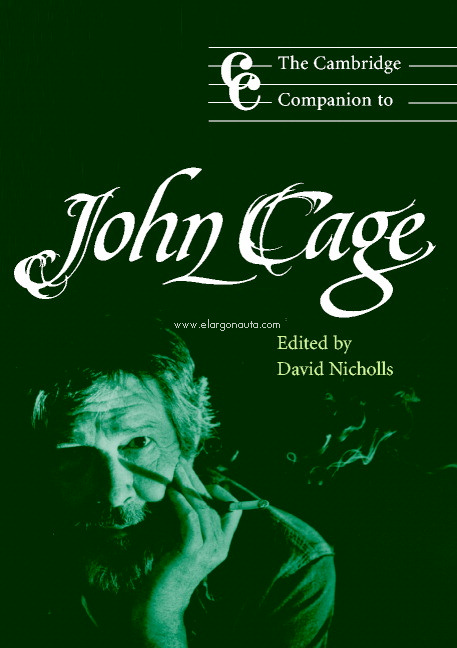
John Cage (1912?1992) was without doubt one of the most important and influential figures in twentieth-century music. Pupil of Schoenberg, Henry Cowell, Marcel Duchamp, and Daisetz Teitaro Suzuki, among others, he spent much of his career in pursuit of an unusual goal: ?giving up control so that sounds can be sounds?, as he put it. This book celebrates the richness and diversity of Cage?s achievements - the development of the prepared piano and of the percussion orchestra, the adoption of chance and of indeterminacy, the employment of electronic resources and of graphic notation, and the questioning of the most fundamental tenets of Western art music. Besides composing around 300 works, he was also a prolific performer, writer, poet, and visual artist. Written by a team of experts, this Companion discusses Cage?s background, his work, and its performance and reception, providing in sum a fully rounded portrait of a fascinating figure
- A full account of one of the most influential composers in the late twentieth century
- Covers all aspects of Cage - his music, his writings, his art and his philosophy
- Written by an international team of Cage experts from a wide perspective, summarising recent scholarship
CONTENIDO
List of illustrations
Notes on contributors
Preface
Acknowledgements
Chronology
Part I. Aesthetic Contexts:
1. Cage and America (David Nicholls)
2. Cage and Europe (Christopher Shultis)
3. Cage and Asia: history and sources (David W. Patterson)
Part II. Sounds, Words, Images:
4. Music I: to the late 1940s (David W. Bernstein)
5. Words and writings (David W. Patterson)
6. Towards infinity: Cage in the 1950s and 1960s (David Nicholls)
7. Visual art (Kathan Brown)
8. Music II: from the late 1960s (William Brooks)
Part III. Interaction and Influence:
9. Cage?s collaborations (Leta E. Miller)
10. Cage and Tudor (John Holzaepfel)
11. Cage and high modernism (David W. Bernstein)
12. Music and society (William Brooks)
13. Cage and postmodernism (Alastair Williams)
14. No escape from heaven: John Cage as father figure (Kyle Gann)
Endnotes
Bibliography
Index


Disponible en breve
Si se pide hoy, se estima recibir en la librería el 09/04/2026
Disponible en breve
Sin stock. Si se pide hoy, se estima recibir en la librería el 10/04/26¡GASTOS DE ENVÍO GRATIS!
Disponible
SÓLO 1 EN STOCK - dato actualizado el 03/04/26 a las 23:05¡GASTOS DE ENVÍO GRATIS!
Bajo pedido
Si se pide hoy, se estima recibir en la librería el 20/04/2026¡GASTOS DE ENVÍO GRATIS!
Disponible
3 EN STOCK - dato actualizado el 03/04/26 a las 23:05¡GASTOS DE ENVÍO GRATIS!
Disponible
2 EN STOCK - dato actualizado el 03/04/26 a las 23:05¡GASTOS DE ENVÍO GRATIS!